

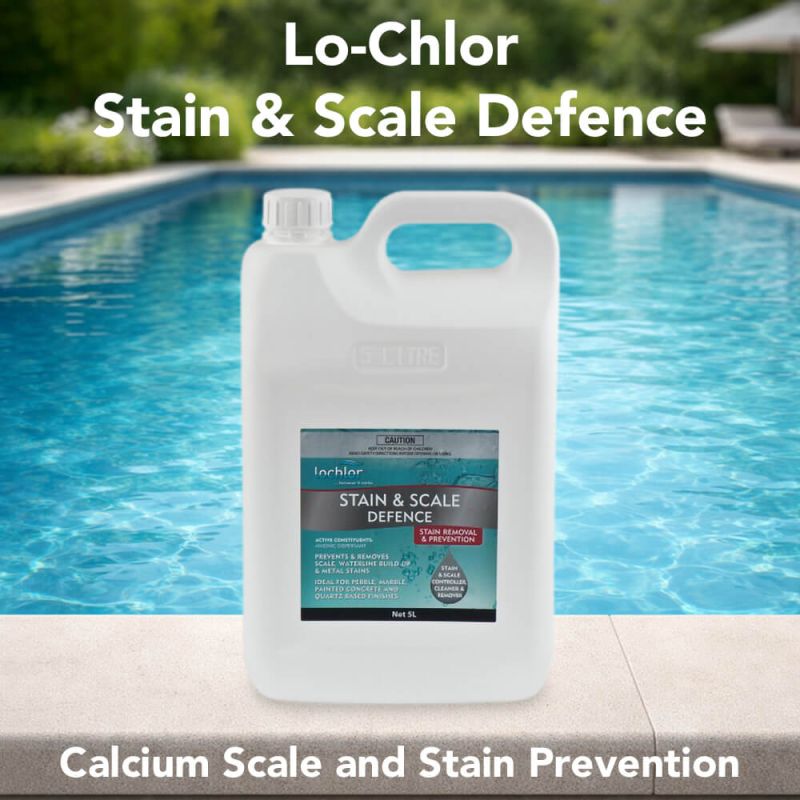
Lo-Chlor Stain & Scale Defence 5L – Pool Chemical

In stock
Order now while supplies last!


Satisfaction Guarantee
All products covered

Same Day Dispatch
On orders placed by 12pm AEDT

Price Match
Quick, simple & easy

Secure Shipping with Tracking
Guaranteed to arrive safely

Flat rate shipping
Per order Australia-wide

Free, Easy Returns
Hassle-free and convenient

Customer Service & Support
Dedicated call center
Stain and Scale Defence for Pool Surfaces and Equipment
Lo-Chlor Stain & Scale Defence is a calcium scale inhibitor formulated to help reduce and manage scale build-up on swimming pool surfaces and pool equipment.
It works as an anionic, non-phosphate dispersant that helps limit the formation of calcium scale while softening existing deposits, making them easier to manage through normal pool maintenance.
In addition to scale control, Stain & Scale Defence assists in reducing metal-related discolouration, scum formation, and filter plugging, supporting cleaner surfaces and more consistent system performance over time.
Features & Benefits
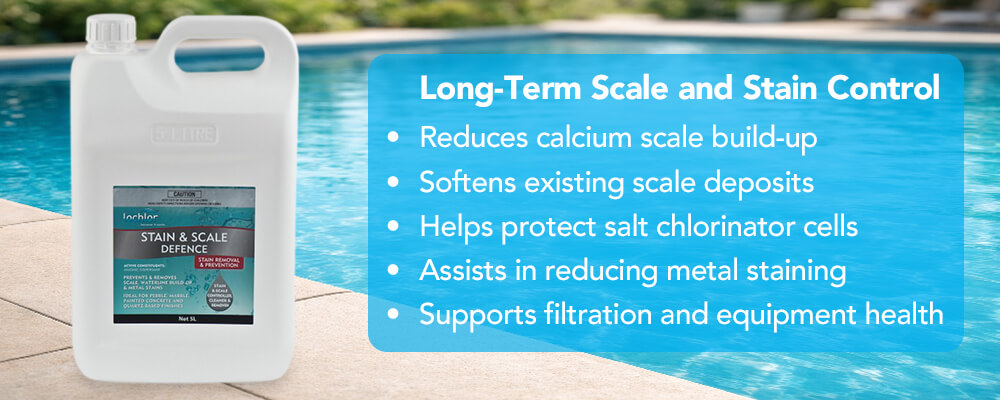
- Reduces calcium scale build-up – helps limit scale formation on pool surfaces.
- Softens existing scale deposits – makes calcium build-up easier to manage and remove.
- Protects salt chlorinator cells – helps reduce calcium scale on cell plates, supporting efficient operation.
- Helps reduce staining and rust discolouration – assists in managing metal-related staining.
- Supports filtration efficiency – helps limit scum formation and filter plugging.
- Assists in protecting pool equipment – helps reduce corrosion of metal components in circulation systems.
- Suitable for a wide range of pool finishes – including pebble, marble, painted concrete, quartz, and exposed aggregate.
How It Works
Stain & Scale Defence works by dispersing calcium and metal ions in the water before they can bind together and form hard, insoluble deposits on pool surfaces and equipment.
By keeping these materials in suspension, the product helps reduce the likelihood of scale formation, staining, and surface discolouration, while also softening existing deposits to improve ongoing pool maintenance.
How to Use
- Initial application: Add the required initial dose directly to the pool, broadcasting over as wide an area as possible.
- Ongoing protection: Apply periodic maintenance doses throughout the swimming season.
- Seasonal use: Suitable for use at pool start-up, after renovations, and prior to winterising or extended periods of inactivity.
Dosage & Coverage
- Initial dose: 5 L per 50,000 litres of pool water.
- Maintenance dose: 1 L per 50,000 litres of pool water, applied monthly.
Important Usage & Compatibility Information
- Backwash or clean the filter before application for best results.
- If calcium hardness exceeds 500 ppm, treat high hardness first by dilution or using a calcium hardness reducer.
- Scale composition can vary; some scale types are influenced by phosphate levels in the water.
- Test phosphate levels before treatment using a phosphate test kit.
- If phosphate levels exceed 0.2 ppm, reduce phosphates using Lo-Chlor Starver M.
- If phosphate levels exceed 1.5 ppm, treat first with Lo-Chlor Starver X, then follow with Lo-Chlor Starver M.
- Once phosphate levels are below 0.2 ppm, Stain & Scale Defence can be applied as part of ongoing scale and stain management.
Pro Tip: To remove scale discolouration on waterline tiles, raise the water level above the line and maintain for at least 3 weeks.
Why Choose Lo-Chlor Stain Busters?
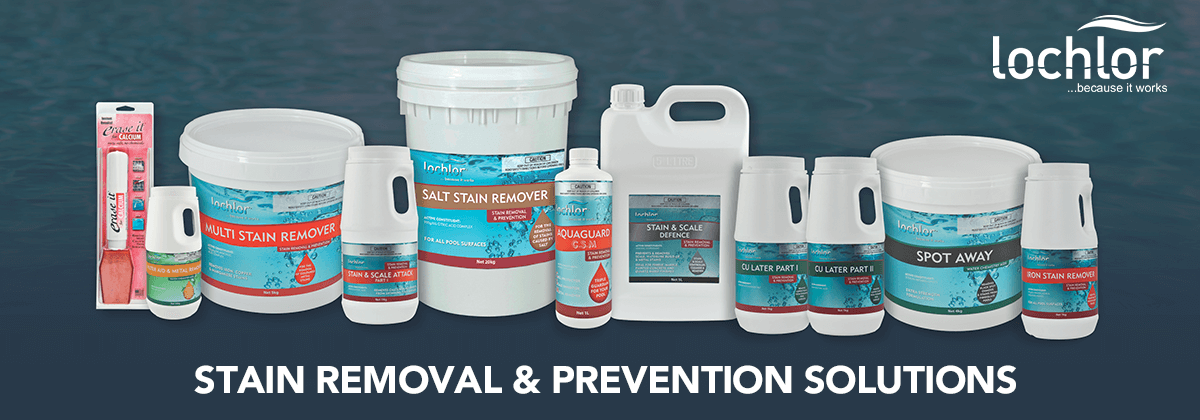
Lo-Chlor Stain Busters is a specialised range developed to manage the many different types of pool stains and scale conditions — because no two pools behave the same way.
Each product in the range targets a specific cause, from calcium scale and mineral deposits to metal staining, helping pool owners apply the right treatment at the right stage for more reliable, long-term results.
Manufactured in Australia and trusted by pool professionals, Lo-Chlor Stain Busters products are formulated for real-world pool conditions, supporting cleaner surfaces, protected equipment, and smarter ongoing pool care.
Frequently Asked Questions
How do I work out what type of stain I have?
Pool stains aren’t always obvious — the same stain can look different depending on the surface, lighting, and water conditions. The most reliable approach is to test the stain before choosing a treatment.
If you’re unsure, start with a small spot test (below) and treat a small area first.
What’s a simple spot test to compare metal vs organic stains?
Stains can look similar, so a small spot test can help point you in the right direction. Always test a small, inconspicuous area first:
- Vitamin C test: Place a vitamin C tablet (ascorbic acid) in a thin sock and hold it on the stain for 1–2 minutes. If it lightens, the stain may be metal-related (often iron).
- Chlorine test: Place a small amount of granular chlorine (or a tablet) in a sock and briefly hold it on the stain. If it lightens, the stain may be organic (such as algae or leaf staining). Do not leave in contact for long, especially on vinyl.
If neither test changes the stain, it may be scale, oxidation, or a surface-specific issue that needs a different approach.
Is it a stain, scale, or surface oxidation?
- Scale is a mineral deposit (often calcium) that usually looks chalky or milky and can feel rough, like sandpaper.
- Oxidation can give fibreglass or painted surfaces a dull, milky, or chalky look (often linked to water balance and sanitiser management over time).
- Stains are colour changes on the surface and can be small patches or cover large areas.
Correct identification matters because different causes respond to different treatments.
Where do metals in pool water usually come from?
Metals can enter pool water in several common ways, including:
- Salt additions (salt can contain trace metals such as iron).
- Top-up water, especially bore or mineral-rich water (iron, manganese, copper).
- Long-term use of some liquid chlorines (trace metals can build up over time).
- Metal-based algaecides (often copper-based).
- Metal fixtures (more common in some above-ground pools).
- Runoff and garden dirt after heavy rain or hosing near the pool.
Why do stains sometimes come back weeks after treatment?
With metal staining, lifting the mark from the surface is only part of the process. The metal can still be present in the water and may re-oxidise and re-deposit later if the source isn’t addressed.
For longer-term results, focus on both:
- Managing the cause (top-up water, salt additions, runoff, metal-based products), and
- Ongoing prevention with the appropriate Stain Busters product for your stain type.
Do I need to adjust chlorine before using stain treatments?
Some stain treatments work best when chlorine is kept at normal maintenance levels (not elevated). High chlorine can reduce the effectiveness of certain stain removal processes.
Follow the directions on the specific Stain Busters product you’re using, and avoid shock dosing immediately before stain treatment unless the label instructs otherwise.
What should I do before and after stain treatment for best results?
- Test first: Identify the stain type with a small spot test and treat a small area before committing to a full treatment.
- Circulation matters: Run the pump to help distribute treatment evenly and support filtration.
- Keep water balanced: Stable pH and alkalinity help reduce re-deposit risk and support consistent results.
- Clean filtration: Ensure the filter is operating efficiently (backwash/clean if needed) so the system can capture and remove what it can.
Is Stain Busters suitable for all pool surfaces?
Stain behaviour can vary by surface type (fibreglass, plaster, tiled, vinyl, painted). Always treat a small area first and follow product directions.
For vinyl (especially patterned liners), take extra care with spot treatments using chlorine, as prolonged contact may bleach the surface.
Can I combine stain products or add them together?
Avoid adding multiple chemicals at the same time. Do not pre-mix products in a bucket.
Add one product, allow it to circulate, then retest and follow the label before adding anything else. This helps prevent unwanted interactions and keeps treatments more predictable.

| SKU | 70SD5L |
|---|---|
| GTIN | 9312113004051 |
| Barcode | 9312113020358 |
| Brand | Lo-Chlor |
| Model | Stain & Scale Defence - 5L |
| Product Type | Pool Chemical |
| Shipping Type | Standard |
| Chemical Type | Stain & Scale |
| Chemical Function | Scale Inhibitor / Scale Stop, Stain Remover |
| Active Constituents | Edetate sodium tetrahydrate: 2.5–7.5% Other non-hazardous ingredients including water: to 100% |

Shipping
Same-day dispatch applies to orders received by 12.00 pm (AEST) during business days. Orders received after 12.00 pm and on weekends or public holidays will be dispatched on the next business day.
Delivery fees are $19.95 flat-rate per order Australia-wide, no matter how many products are in it. Orders containing bulky items like sand filters, acoustic boxes, heat pumps, pool covers, and pool slides may incur additional fees as they require specialized carriers.
Below are the estimated time to arrival in business days once an order is shipped.
| Destination | Sydney | NSW | VIC | QLD | SA | WA/NT |
|---|---|---|---|---|---|---|
| Business Days | 1 - 2 | 2 - 4 | 2 - 4 | 2 - 4 | 3 - 4 | 5 - 6 |
Rural and remote addresses, where delivery is not provided every day, may take longer.
Returns
Satisfaction Guarantee: If you are not satisfied with a product for any reason, you are welcome to return it to us for a full refund or exchange within 30 days of the purchase date - even if you have used the product. Returns are free, and we will cover return shipping.
We take full responsibility for the safe arrival of the products that you order from us. We will replace at our expense any product that arrives faulty, damaged during transit, or is the incorrect product. Click here for details
If you have any questions about our shipping policy or our return policy, please contact us on 1300 766 619 or through our contact us form.