


(DG) Note: This product cannot be shipped. It can be purchased at any of our stores. Store Locations.
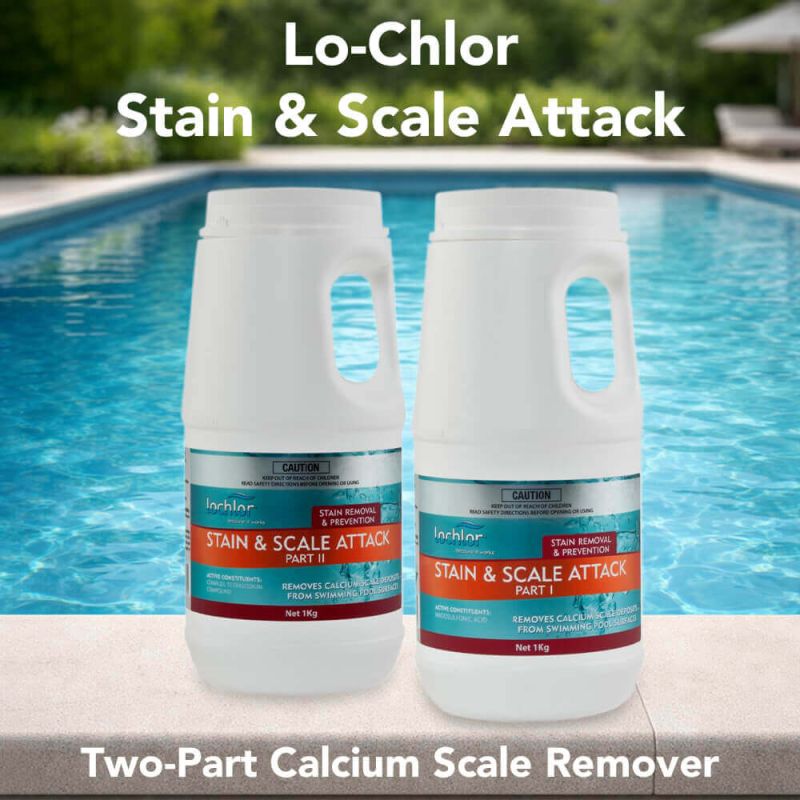
Lo-Chlor Stain & Scale Attack 2 Part Pack 2 x 1kg – Pool Chemical (DG)
Two-part treatment for attacking calcium scale in swimming pools, with added benefit as an effective copper stain remover.

$50.00
- Buy 2 for $47.00 each and save 6%
- Buy 3 for $44.00 each and save 12%

Satisfaction Guarantee
All products covered

Same Day Dispatch
On orders placed by 12pm AEDT

Price Match
Quick, simple & easy

Secure Shipping with Tracking
Guaranteed to arrive safely

Flat rate shipping
Per order Australia-wide

Free, Easy Returns
Hassle-free and convenient

Customer Service & Support
Dedicated call center
Calcium Scale and Stain Removal for Pool Surfaces
Lo-Chlor Stain & Scale Attack is a two-part treatment that attacks calcium scale in swimming pools and removes calcium deposits from pool surfaces.
It combines two highly concentrated formulations of organic acids and chelating agents to fight calcium scale, while also being suitable for use as an effective copper stain remover.
This is a slow-acting treatment intended for pools where calcium scale has built up over time and requires a corrective treatment approach.
Features & Benefits
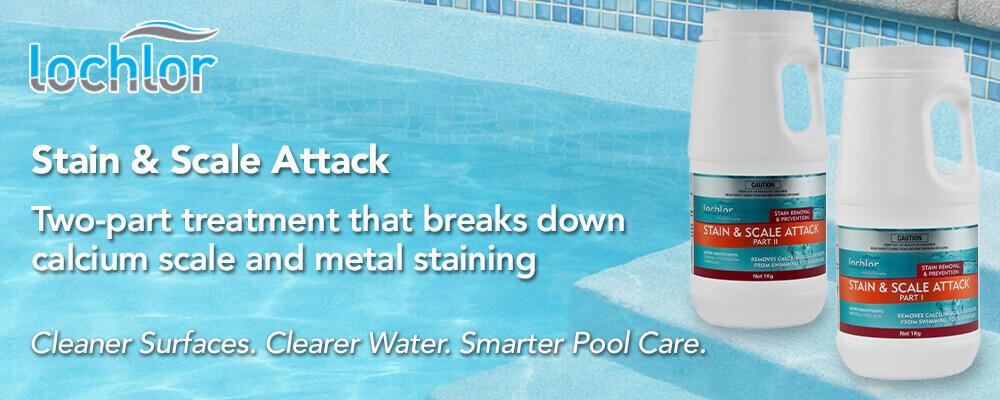
- Concentrated calcium scale remover – formulated to attack and reduce calcium deposits on pool surfaces.
- Two-part treatment system – combines Part I and Part II to create a concentrated stain and scale removal solution.
- Also effective on copper staining – can be used to assist in removing copper-related discolouration.
- Full-pool corrective treatment – applied around the pool perimeter for broad surface coverage.
- Slow-working restoration process – suitable for pools where scale removal requires a gradual corrective approach.
How It Works
Stain & Scale Attack works by combining Part I (acid-based) and Part II (chelating agent) into a single treatment that gradually breaks down calcium scale on pool surfaces.
Part I helps loosen and dissolve hardened scale deposits, while Part II binds with the released minerals and metals to keep them suspended in the water.
This process prevents the material from reattaching to surfaces and allows it to be carried through the filtration system over time, which is why results develop progressively rather than immediately.
How to Use
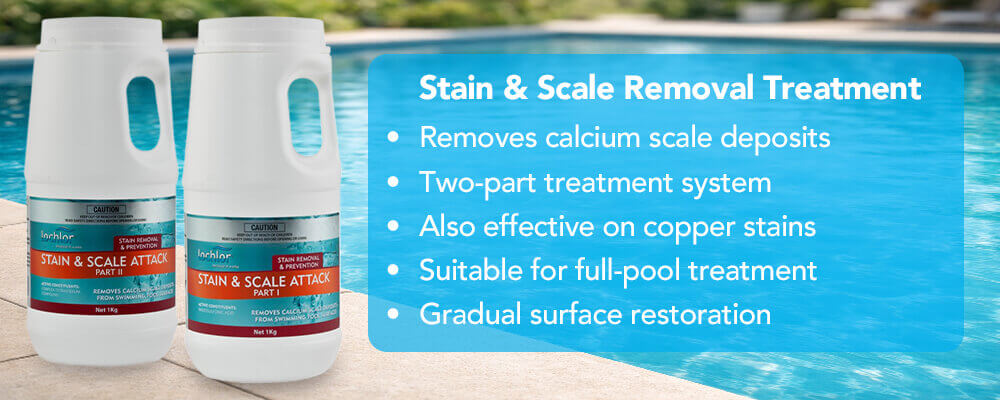
- Ensure chlorine is below 1.0 ppm and pH is 7.0.
- Add Part I to a bucket of water and mix until dissolved, then add Part II to the same solution and mix thoroughly.
- Pour the mixed solution around the perimeter of the pool, trying to cover as great an area as possible.
- Run the pump, filter, and chlorinator as normal after application.
- Allow the pool to filter for at least 24 hours after treatment.
Dosage & Coverage
- Pack size: 2 x 1 kg (Part I and Part II).
- Coverage: One complete pack treats up to 50,000 litres of pool water.
Important Usage & Compatibility Information
- This is a slow-acting treatment, and results may take up to 4–6 weeks to become visible.
- Do not sprinkle directly onto pool surfaces. The product must always be mixed in a bucket of water first.
- Pool water may become cloudy immediately after application. This cloudiness should usually disappear within 5–10 minutes.
- Rebalance the pool water after approximately 5–7 days.
- To help prevent new calcium scale build-up, follow with Lo-Chlor Stain & Scale Defence.
This product is classified as Dangerous Goods. Handle with care, avoid contact with skin and eyes, and keep out of reach of children.
Why Choose Lo-Chlor Stain Busters?
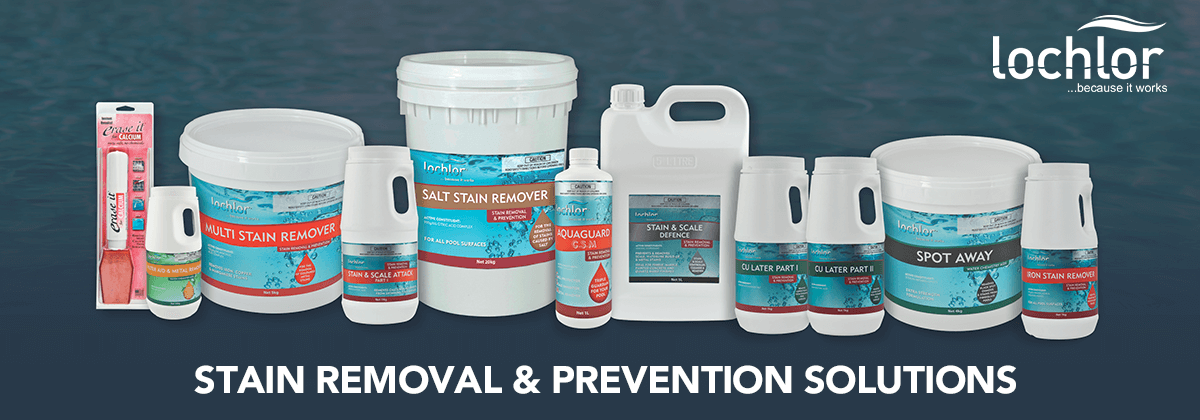
Lo-Chlor Stain Busters is a specialised range created to tackle different types of pool stains and scale, because no single treatment suits every pool condition.
The range includes targeted products for stain removal, scale treatment, and ongoing prevention, helping pool owners and pool professionals take a more accurate approach to problem solving.
Manufactured in Australia and trusted by pool professionals, Lo-Chlor formulations are made for real-world pool conditions and long-term pool care.
Frequently Asked Questions
How do I work out what type of stain I have?
Pool stains are not always easy to identify. The same stain can look different depending on the pool surface, lighting, and water conditions.
The best starting point is to test the stain before choosing a treatment. If you are unsure, begin with a small spot test and treat a small area first.
What’s a simple spot test to compare metal vs organic stains?
A simple spot test can help indicate what type of stain you may be dealing with. Always test a small, inconspicuous area first:
- Vitamin C test: Place a vitamin C tablet (ascorbic acid) in a thin sock and hold it on the stain for 1–2 minutes. If the stain lightens, it may be metal-related.
- Chlorine test: Place a small amount of granular chlorine or a tablet in a sock and briefly hold it on the stain. If it lightens, it may be an organic stain, such as algae or leaf staining. Do not leave it in contact for long, especially on vinyl surfaces.
If neither test changes the stain, it may be calcium scale, oxidation, or another surface-related issue that needs a different treatment approach.
Is it a stain, scale, or surface oxidation?
- Scale is a mineral deposit, usually calcium-based, that often looks chalky or milky and feels rough, like sandpaper.
- Oxidation can give fibreglass or painted surfaces a dull, milky, or chalky appearance, often linked to water balance and sanitiser management over time.
- Stains are colour changes on the surface and may appear as small patches or affect larger areas.
Correct identification matters because different problems respond to different treatments.
Where do metals in pool water usually come from?
Metals can enter pool water in a number of common ways, including:
- Salt additions, which can contain trace metals such as iron.
- Top-up water, especially bore water or mineral-rich water.
- Long-term use of some liquid chlorines, where trace metals can build up over time.
- Metal-based algaecides, often copper-based.
- Metal fixtures, especially in some above-ground pools.
- Runoff and garden dirt entering the pool after rain or hosing nearby areas.
Why do stains or scale sometimes come back after treatment?
Removing the visible deposit from the pool surface is only part of the process. If the underlying cause is still present, the problem may return later.
For longer-term results, it is important to manage both the visible issue and the cause, such as poor water balance, metal in fill water, salt additions, runoff, or metal-based pool products.
What should I do before and after stain or scale treatment for best results?
- Test first: Identify the problem and treat a small area first if needed.
- Follow the product directions carefully: For Lo-Chlor Stain & Scale Attack, chlorine should be below 1.0 ppm and pH should be around 7.0.
- Keep water circulating: Run the pump and filtration system as directed to help distribute the treatment.
- Rebalance afterwards: After treatment, rebalance the pool water as recommended.
- Focus on prevention: Ongoing scale or stain control may be needed if the source of the problem remains.

| SKU | 70sap1/70sap2 |
|---|---|
| GTIN | 9312113020365 |
| Barcode | 9312113020372 |
| Warranty | 1 Year |
| Brand | Lo-Chlor |
| Model | Stain & Scale Attack 2 Part Pack (2 x 1Kg) |
| Product Type | Pool Chemical |
| Shipping Type | Standard |
| Chemical Type | Stain & Scale |
| Chemical Function | Scale Remover, Stain Remover |
| Active Constituents | Part I – Sulfamic acid: >900 g/kg Other non-hazardous ingredients: to 100% Part II – EDTA tetrasodium salt (tetrahydrate): >80% Other non-hazardous ingredients: to 100% |
Shipping
Same-day dispatch applies to orders received by 12.00 pm (AEST) during business days. Orders received after 12.00 pm and on weekends or public holidays will be dispatched on the next business day.
Delivery fees are $19.95 flat-rate per order Australia-wide, no matter how many products are in it. Orders containing bulky items like sand filters, acoustic boxes, heat pumps, pool covers, and pool slides may incur additional fees as they require specialized carriers.
Below are the estimated time to arrival in business days once an order is shipped.
| Destination | Sydney | NSW | VIC | QLD | SA | WA/NT |
|---|---|---|---|---|---|---|
| Business Days | 1 - 2 | 2 - 4 | 2 - 4 | 2 - 4 | 3 - 4 | 5 - 6 |
Rural and remote addresses, where delivery is not provided every day, may take longer.
Returns
Satisfaction Guarantee: If you are not satisfied with a product for any reason, you are welcome to return it to us for a full refund or exchange within 30 days of the purchase date - even if you have used the product. Returns are free, and we will cover return shipping.
We take full responsibility for the safe arrival of the products that you order from us. We will replace at our expense any product that arrives faulty, damaged during transit, or is the incorrect product. Click here for details
If you have any questions about our shipping policy or our return policy, please contact us on 1300 766 619 or through our contact us form.